

Blog

  • North Sentinel Island: The World’s Most Dangerous and Isolated Island


    North Sentinel Island, located in the Bay of Bengal, India, is one of the most mysterious and dangerous places on Earth. It is home to the Sentinelese, one of the last uncontacted tribes in the world, who fiercely resist outside contact. Visiting the island is strictly forbidden, making it a unique and extreme destination that remains almost entirely untouched by modern civilization.

    The island is not just remote; it is a place where human curiosity meets one of the strictest forms of isolation.

    Where Is North Sentinel Island?

    North Sentinel Island is part of the Andaman and Nicobar Islands, a chain of islands in the Bay of Bengal. It lies approximately:

    • 36 kilometers (22 miles) west of Port Blair, the capital of the Andaman Islands
    • Surrounded by coral reefs and shallow waters, making it difficult to approach by boat

    The island covers roughly 59 square kilometers (23 square miles) and is densely forested, with sandy beaches and mangroves along its coastline.

    Who Are the Sentinelese?

    The Sentinelese are an indigenous tribe that has lived on North Sentinel Island for thousands of years. They are considered one of the last uncontacted peoples in the world.

    Key characteristics include:

    • They live in small, scattered communities
    • They rely on hunting, fishing, and gathering for survival
    • They use bows, arrows, and spears for defense and hunting
    • They actively reject contact with outsiders, often with hostility

    The Indian government has declared the island off-limits to protect the tribe and prevent the spread of diseases, as the Sentinelese have no immunity to common illnesses.

    Why Is North Sentinel Island Dangerous?

    North Sentinel Island is considered one of the most dangerous places to visit because of the tribe’s aggressive defense of their territory.

    • Outsiders approaching the island have been shot at with arrows and spears.
    • Attempts to land or make contact are met with immediate hostility.
    • The island is surrounded by reefs and shallow waters, increasing the risk of shipwrecks.

    Several incidents illustrate the dangers:

    • In 2006, two fishermen illegally approached the island and were killed by the Sentinelese.
    • In 2018, an American missionary attempting to contact the tribe was killed after landing on the island.

    The island’s hostility ensures that it remains one of the few places on Earth that humans are prohibited from entering.

    Legal Protection

    The Indian government strictly enforces a law prohibiting travel within 5 kilometers (3 miles) of the island. This measure serves to:

    • Protect the Sentinelese from outside diseases
    • Preserve their way of life
    • Ensure the safety of outsiders

    Violating these laws can result in legal penalties, including fines and imprisonment.

    Geography and Environment

    North Sentinel Island is heavily forested, with thick jungle covering most of the land. Its beaches are narrow and bordered by coral reefs, which make navigation by boat hazardous.

    The island is rich in natural resources:

    • Fish and marine life provide food for the Sentinelese
    • Tropical fruits and nuts grow in the forest
    • Freshwater sources exist but are limited

    Despite its small size, the island supports a self-sufficient community that has survived in isolation for centuries.

    Why North Sentinel Island Fascinates the World

    The island captures global attention because it is:

    • Mysterious: Almost nothing is known about the tribe’s culture, language, or traditions.
    • Extreme: Human contact is strictly forbidden, and approaching it is life-threatening.
    • Unique: It is one of the last remaining examples of humans living entirely outside modern society.

    The combination of danger, isolation, and mystery makes North Sentinel Island a symbol of untouched human history.

    Lessons from the Island

    North Sentinel Island reminds us of:

    • The importance of respecting indigenous peoples’ rights
    • The dangers of human intrusion into isolated ecosystems
    • The resilience of humans living sustainably in extreme isolation

    It also shows that not all parts of the world are meant to be explored, even in the age of globalization.

    Final Thoughts

    North Sentinel Island is unlike any other destination on Earth. Its dense forests, dangerous waters, and fiercely protective inhabitants make it one of the most extreme and inaccessible places in the world.

    For travelers, the island is more a story of mystery and caution than a place to visit. It represents the ultimate boundary between human curiosity and respect for isolation.

    North Sentinel Island is a powerful reminder that some places are meant to remain untouched, and some peoples are meant to live entirely on their own terms.


  • Pripyat, Ukraine: The Ghost City Frozen in Time

    Pripyat, Ukraine: The Ghost City Frozen in Time


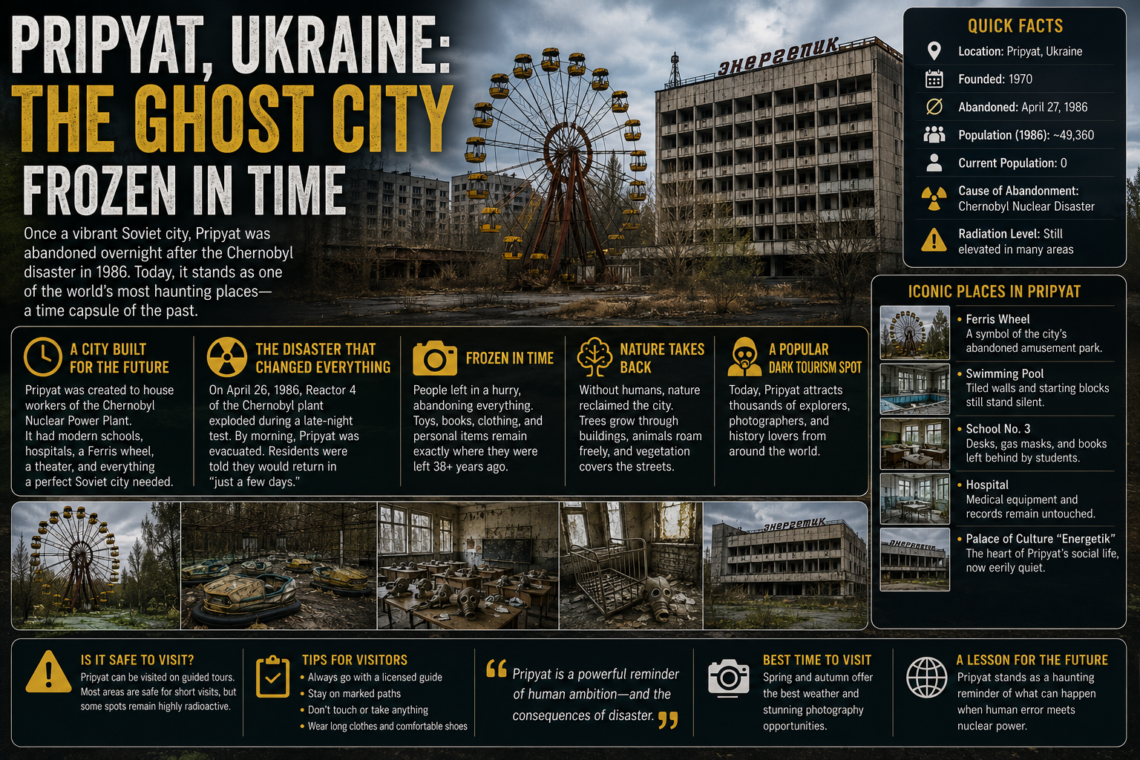
    Pripyat, Ukraine, is one of the most haunting and fascinating places on Earth. Once a thriving city built to house workers at the nearby Chernobyl Nuclear Power Plant, Pripyat was evacuated almost overnight after the catastrophic explosion at Reactor No. 4 in 1986. Today, it stands as a ghost town, frozen in time, offering a glimpse into life abandoned by humans but reclaimed by nature.

    Visiting Pripyat is like stepping into a real-life post-apocalyptic world, where silence, decay, and memories of a sudden disaster dominate the landscape.

    Where Is Pripyat Located?

    Pripyat is located in northern Ukraine, just 3 kilometers from the Chernobyl Nuclear Power Plant. The city lies within the Chernobyl Exclusion Zone, a 30-kilometer radius around the reactor where radiation levels remain high and human habitation is prohibited.

    Pripyat was once home to nearly 50,000 people, mostly plant workers and their families. It was considered a model Soviet city, with schools, hospitals, apartment blocks, and recreational facilities.

    The History of Pripyat

    Pripyat was founded in 1970 to accommodate workers building the Chernobyl Nuclear Power Plant. The city was modern, featuring:

    • Schools and kindergartens
    • Hospitals and clinics
    • Shops, restaurants, and sports facilities
    • A cultural palace for events and theater performances
    • A stadium and amusement park

    Life in Pripyat was vibrant, reflecting optimism in Soviet technological progress and nuclear energy.

    The Chernobyl Disaster and Evacuation

    On April 26, 1986, Reactor No. 4 exploded, releasing massive amounts of radioactive material into the environment. Within 36 hours, authorities evacuated Pripyat, telling residents they would be able to return in a few days.

    Most residents never returned. Personal belongings, toys, furniture, and documents were left behind. Buildings were sealed, and nature slowly began reclaiming the city.

    Exploring the Ghost City

    Pripyat is one of the most visited parts of the Chernobyl Exclusion Zone for guided tours. Visitors encounter:

    Abandoned Buildings

    Apartment complexes, schools, hospitals, and offices are left in decaying silence. Furniture, books, and household items remain where they were abandoned, creating an eerie snapshot of 1980s life.

    The Amusement Park

    Pripyat’s amusement park, which was scheduled to open just days after the disaster, never welcomed visitors. Its Ferris wheel, bumper cars, and carousel remain rusting symbols of lost innocence.

    Schools and Hospitals

    Classrooms with chalkboards still contain lesson notes. Hospital wards contain abandoned medical equipment. These buildings offer a chilling reminder of lives abruptly disrupted.

    Street Signs and Vehicles

    Rusting cars, bicycles, and street signs are frozen in place, overtaken by plants and trees. The quiet streets feel otherworldly, with an almost surreal sense of time standing still.

    Nature Reclaims the City

    Since the evacuation, Pripyat has been slowly reclaimed by nature. Trees grow through buildings, wild animals roam the streets, and birds nest in abandoned structures.

    Species now thriving in the exclusion zone include:

    • Wolves and foxes
    • Deer and wild boar
    • Birds of prey and small mammals

    Ironically, the absence of humans has allowed wildlife populations to flourish, turning Pripyat into an unintended wildlife sanctuary.

    Safety and Visiting Pripyat

    Visiting Pripyat requires a guided tour due to lingering radiation risks. Safety precautions include:

    • Dosimeters to monitor radiation exposure
    • Avoiding contact with surfaces or debris
    • Wearing protective clothing in certain areas
    • Staying within authorized zones

    Tours provide a safe way to experience the city’s haunting atmosphere while respecting environmental and safety regulations.

    Why Pripyat Fascinates People

    Pripyat captivates travelers and photographers for several reasons:

    • Historical significance: It tells the story of the Chernobyl disaster and human error.
    • Eerie beauty: Decay, rust, and overgrown structures create hauntingly photogenic scenes.
    • Time capsule: The city preserves a snapshot of 1980s Soviet life.
    • Human curiosity: The combination of danger and mystery draws adventurers.

    The city has been featured in films, documentaries, video games, and literature, amplifying its global recognition.

    Lessons from Pripyat

    Pripyat serves as a stark reminder of:

    • The consequences of technological failures
    • The vulnerability of human settlements to disasters
    • The resilience of nature when humans are absent

    It encourages reflection on how humanity interacts with the environment and the importance of safety and preparedness.

    Final Thoughts

    Pripyat, Ukraine, is more than a ghost town — it is a window into history, a monument to human ambition and tragedy, and a testament to nature’s ability to reclaim spaces.

    For travelers seeking history, extreme destinations, and haunting landscapes, Pripyat offers a rare opportunity to witness a world frozen in time.

    Walking its silent streets, seeing abandoned schools, and gazing at the rusting Ferris wheel, visitors can feel the weight of a city left behind — a city that will never truly return.


  • Mariana Trench: The Deepest Place on Earth

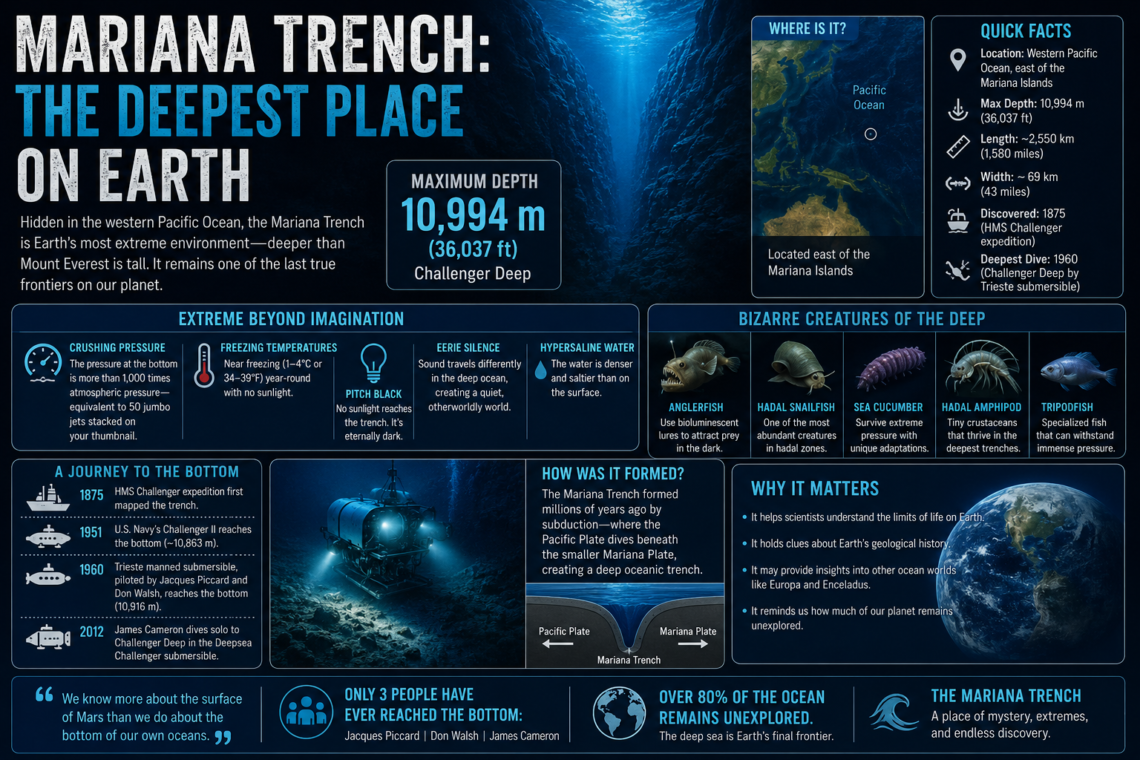
    The Mariana Trench is the deepest part of the world’s oceans, a place so extreme and remote that it remains largely unexplored. Located in the western Pacific Ocean, east of the Mariana Islands, this underwater canyon plunges to incredible depths, far beyond what most humans can experience.

    It is a place of mystery, danger, and scientific fascination, offering insights into the planet’s geology, oceanography, and life under extreme conditions.

    Where Is the Mariana Trench Located?

    The Mariana Trench stretches over 2,550 kilometers (1,580 miles) and is about 69 kilometers (43 miles) wide at its widest point. Its deepest section is known as the Challenger Deep, which reaches approximately 10,935 meters (35,876 feet) — nearly 11 kilometers below sea level.

    This depth is so extreme that Mount Everest could easily fit inside the trench, with its peak still submerged under more than a kilometer of water.

    The trench lies in the Pacific Ocean, east of the Mariana Islands and near Guam. Its location is remote, making exploration logistically challenging and expensive.

    How Was the Trench Formed?

    The Mariana Trench is a subduction zone, formed where two tectonic plates collide. The Pacific Plate is being forced beneath the Mariana Plate, creating a deep, narrow canyon on the ocean floor.

    This geological process produces extreme pressures, intense seismic activity, and unusual underwater landscapes, including ridges, cliffs, and deep basins.

    Life in the Mariana Trench

    Despite its extreme conditions — crushing pressures over 1,000 times that at sea level, near-freezing temperatures, and total darkness — life exists in the trench.

    Adapted species include:

    • Giant amoebas that survive on microscopic organisms
    • Deep-sea amphipods (shrimp-like creatures)
    • Snailfish that withstand extreme pressure
    • Bacteria and microorganisms that live off chemical reactions in the rocks

    These organisms have evolved unique adaptations, such as flexible cell membranes and specialized enzymes, allowing survival under enormous pressure and low light conditions.

    Human Exploration

    Exploring the Mariana Trench is extremely difficult due to depth and pressure. Few humans have ever descended to the Challenger Deep.

    Notable Expeditions

    • 1960 – Trieste Submersible: Jacques Piccard and Don Walsh reached the bottom in a bathyscaphe, marking the first manned descent.
    • 2012 – James Cameron: The filmmaker and explorer made a solo dive in the Deepsea Challenger, capturing footage of previously unseen marine life.
    • Recent Expeditions: Modern unmanned submersibles and robotic vehicles continue to explore and map the trench.

    These explorations reveal unique life forms, extreme geological features, and underwater ecosystems unlike anywhere else on Earth.

    Why Is the Mariana Trench Dangerous?

    The trench’s extreme conditions make it inherently dangerous for human exploration:

    • Crushing pressure: At the deepest point, pressure is over 1,000 atmospheres — enough to crush conventional submarines.
    • Freezing temperatures: Water temperatures hover near 1–4°C (34–39°F).
    • Total darkness: Sunlight cannot penetrate these depths.
    • Limited technology: Specialized submersibles are required, and even these are at risk of failure.

    Because of these factors, only highly trained explorers using state-of-the-art equipment can visit safely.

    Scientific Importance

    The Mariana Trench provides critical insights into:

    • Plate tectonics and geology – Understanding subduction zones helps predict earthquakes and tsunamis.
    • Extreme biology – Organisms living here offer clues about adaptation, evolution, and potential life on other planets.
    • Climate history – Sediment samples reveal Earth’s past climate and ocean conditions.

    Studying the trench helps scientists understand the planet’s most extreme environments and the resilience of life.

    Myths and Popular Culture

    The Mariana Trench has inspired countless legends, including:

    • Stories of giant sea monsters
    • Hidden cities or ancient civilizations
    • The trench as a “gateway to the underworld”

    Movies, documentaries, and books often exaggerate the dangers, but its real-life extremes are already astonishing enough.

    Visiting the Mariana Trench

    Unlike a typical travel destination, the trench cannot be visited by ordinary tourists. Access is limited to researchers and explorers in specially designed submarines.

    However, people can experience the area virtually through:

    • Deep-sea footage from expeditions
    • Documentaries and interactive maps
    • Research centers and museums displaying trench discoveries

    For most, learning about it through media is the only feasible way to “visit.”

    Why the Mariana Trench Fascinates the World

    The trench symbolizes:

    • The unknown and unexplored frontiers of Earth
    • Human curiosity and the desire to conquer extreme environments
    • The fragility and adaptability of life under extreme conditions

    Its mystery, beauty, and danger continue to captivate scientists, adventurers, and the general public alike.

    Final Thoughts

    The Mariana Trench is a realm unlike any other on Earth — dark, deep, and deadly. Its extreme pressure, unique life forms, and geological wonders make it one of the most fascinating locations on the planet.

    While few humans will ever descend to its depths, the trench remains a symbol of the limits of exploration, the resilience of life, and the vast mysteries that still exist on our own planet.


  • The Bermuda Triangle: Mystery, Myth, and the Sea of Lost Ships

    The Bermuda Triangle: Mystery, Myth, and the Sea of Lost Ships


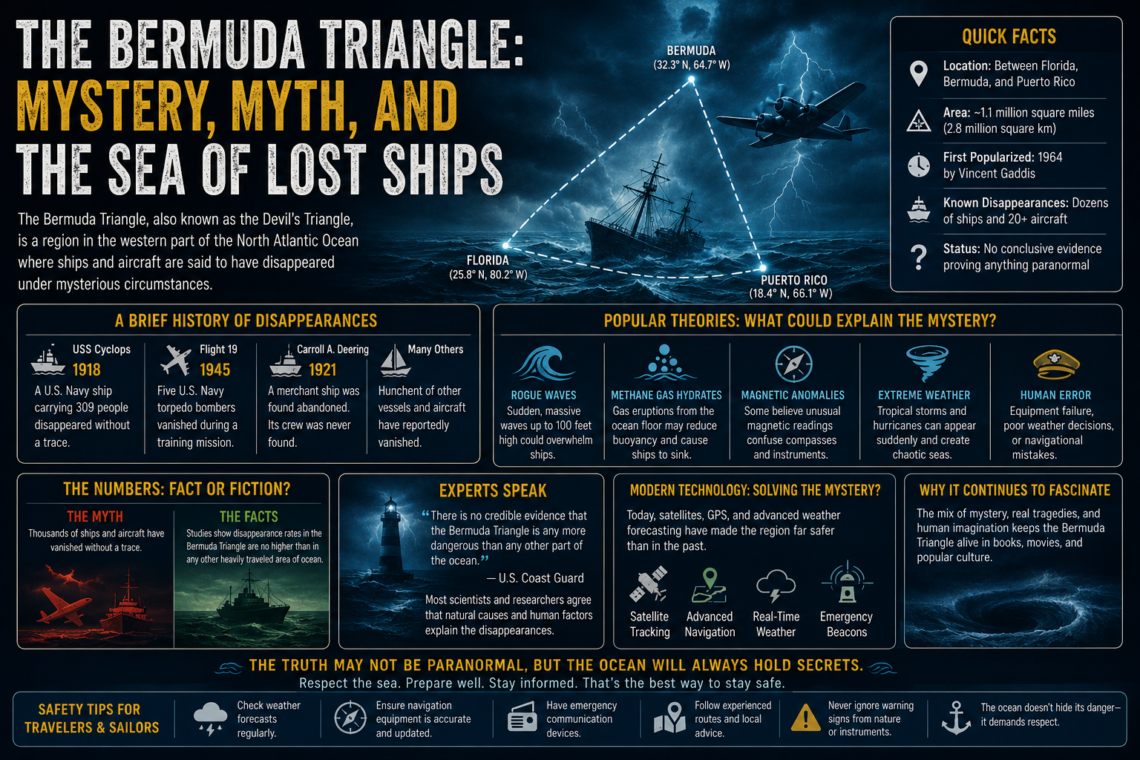
    The Bermuda Triangle, also known as the “Devil’s Triangle,” is one of the most mysterious regions on Earth. Located in the western part of the North Atlantic Ocean, this area has been linked to countless reports of ships, planes, and people disappearing under unexplained circumstances.

    While science provides some logical explanations, the Bermuda Triangle continues to capture the imagination of travelers, adventurers, and conspiracy theorists around the world.

    Where Is the Bermuda Triangle?

    The Bermuda Triangle is roughly defined by three points:

    • Miami, Florida
    • Bermuda
    • San Juan, Puerto Rico

    Within this triangular region, hundreds of vessels and aircraft have reportedly vanished over the past century. The area spans hundreds of thousands of square miles of open ocean, with deep waters, strong currents, and unpredictable weather.

    Famous Disappearances

    Several high-profile disappearances contributed to the Bermuda Triangle’s legendary reputation.

    Flight 19 (1945)

    • A squadron of five U.S. Navy bombers vanished during a training flight.
    • All 14 airmen on board were lost, and a rescue plane sent to find them also disappeared.

    This incident is considered one of the most famous Bermuda Triangle mysteries.

    USS Cyclops (1918)

    • A U.S. Navy cargo ship disappeared without a trace with 306 crew members aboard.
    • No wreckage was ever found, making it the single largest loss of life in U.S. Naval history not directly involving combat.

    Other Cases

    Over the years, dozens of smaller boats, private aircraft, and commercial vessels have reportedly vanished without clear explanation. Many remain missing despite extensive searches.

    Theories Behind the Mystery

    Explanations for the Bermuda Triangle’s strange reputation range from natural phenomena to conspiracy theories.

    Scientific Explanations

    • Rogue waves: Sudden, massive ocean waves can easily capsize ships.
    • Strong currents: The Gulf Stream moves rapidly through the area, carrying debris far from its origin.
    • Compass anomalies: Magnetic variations can cause navigational errors.
    • Weather patterns: Hurricanes, tropical storms, and sudden squalls are common.
    • Methane hydrates: Some researchers suggest underwater gas eruptions could reduce water density, causing ships to sink rapidly.

    Paranormal Theories

    Some theories are more imaginative:

    • Alien abductions
    • Time warps
    • Hidden underwater cities like Atlantis
    • Vortexes to other dimensions

    While entertaining, there is no verified evidence supporting these claims.

    Debunking the Myths

    Despite its reputation, the Bermuda Triangle is not officially recognized as dangerous by the U.S. Board on Geographic Names. Statistically, it does not have a higher rate of accidents than other heavily traveled ocean regions.

    Many reported disappearances have been attributed to human error, mechanical failure, or severe weather.

    Visiting the Bermuda Triangle

    You cannot “visit” the Bermuda Triangle like a land destination, but cruises and flights pass through parts of it regularly. Travelers can:

    • Take cruises from Florida to the Caribbean
    • Fly over the area on commercial or private aircraft
    • Explore nearby islands like Bermuda and Puerto Rico

    While the Triangle remains a subject of intrigue, it is not off-limits or dangerous under normal travel conditions.

    Why the Bermuda Triangle Fascinates People

    The Bermuda Triangle appeals to human curiosity for several reasons:

    • It combines mystery, danger, and the unknown.
    • It has been featured in books, documentaries, and movies.
    • It represents humanity’s fascination with unexplained phenomena.

    Even with rational explanations, the legend persists because it taps into our love for adventure and fear of the unknown.

    Cultural Impact

    The Bermuda Triangle has inspired countless works of fiction, movies, and conspiracy theories. From novels to video games, it symbolizes mystery, danger, and the supernatural.

    Tourist attractions in Bermuda capitalize on this fame, offering themed tours, museums, and souvenir shops.

    Lessons from the Bermuda Triangle

    While the stories are dramatic, they remind travelers of the importance of:

    • Navigational safety
    • Weather awareness
    • Emergency preparedness in open waters

    Science and logic can explain most disappearances, but the human imagination ensures the legend continues.

    Final Thoughts

    The Bermuda Triangle remains one of the world’s most intriguing mysteries. While many incidents have plausible scientific explanations, the combination of unexplained disappearances, cultural fascination, and remote oceanic conditions gives the region a legendary status.

    For travelers, it is less a place to fear and more a story to experience through books, cruises, and flights over the Atlantic. It demonstrates how myths, adventure, and the vast unknown continue to capture our imagination.


  • Lake Natron, Tanzania: The Deadly Yet Beautiful Alkaline Lake

    Lake Natron, Tanzania: The Deadly Yet Beautiful Alkaline Lake


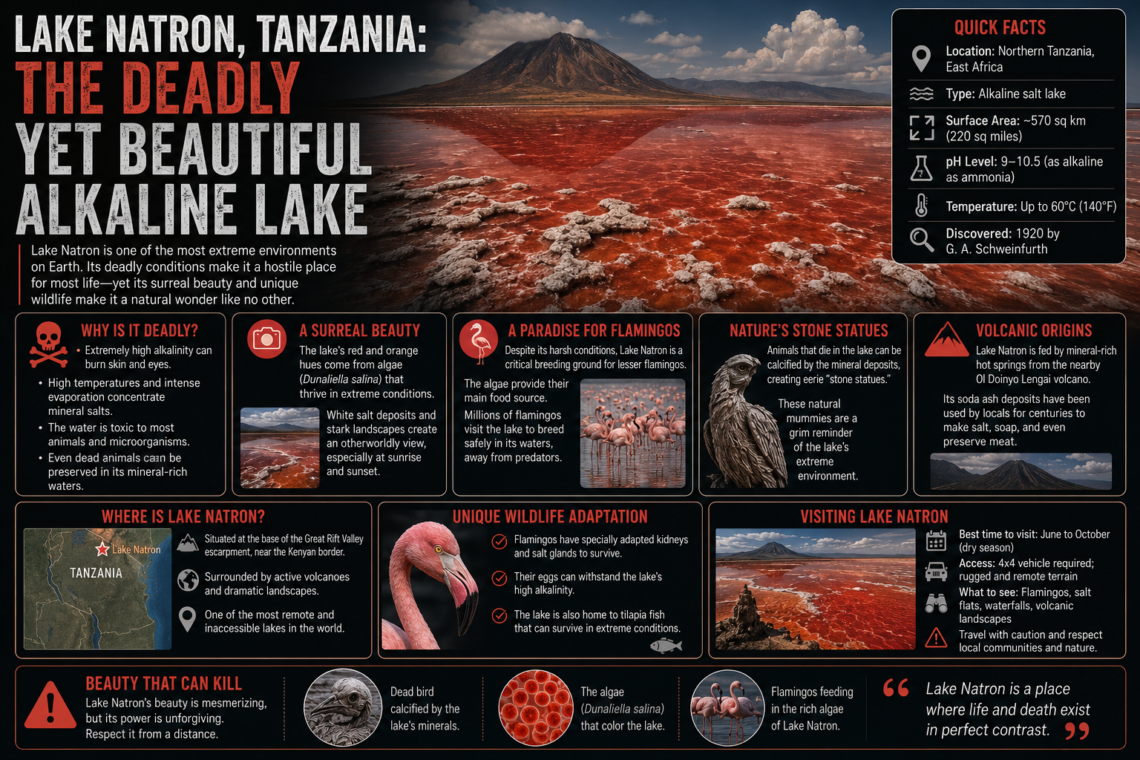
    Lake Natron, located in northern Tanzania near the border with Kenya, is one of the most unusual and dangerous bodies of water on Earth. Famous for its extreme alkalinity, bright red waters, and the eerie “calcified” animals that line its shores, Lake Natron is as fascinating as it is deadly.

    Despite its harsh environment, the lake is a vital habitat for wildlife, especially flamingos, and offers an unforgettable experience for adventurous travelers.

    Where Is Lake Natron Located?

    Lake Natron lies in the East African Rift Valley, approximately 600 meters above sea level. It is part of a chain of alkaline lakes in the region, which also includes Lakes Magadi and Bogoria in Kenya.

    The lake covers about 57 square kilometers, but its size fluctuates dramatically with rainfall. During dry seasons, its edges shrink, revealing the thick, reddish salt crusts.

    Why Is Lake Natron So Dangerous?

    Lake Natron is extremely hostile to most life forms due to several factors:

    • High alkalinity: The lake has a pH as high as 10.5, similar to ammonia.
    • High temperature: In shallow areas, water temperatures can reach 60°C (140°F).
    • Toxic minerals: The water contains large amounts of soda and other minerals.

    These conditions make Lake Natron virtually uninhabitable for humans and most animals. Even a short swim can result in severe chemical burns.

    The alkalinity is so intense that it can calcify dead animals within weeks, leaving behind eerie statues that appear petrified.

    Why Does the Lake Turn Red?

    The reddish color of Lake Natron comes from microorganisms and algae that thrive in the alkaline water. These tiny life forms produce pigments that give the lake its blood-red appearance.

    The red hue intensifies during the dry season when water levels drop and salt concentrations increase.

    From a distance, the lake can appear both beautiful and menacing, like a natural warning sign.

    The Calcified Creatures of Lake Natron

    One of Lake Natron’s most haunting features is its calcified animals. Birds, bats, and small mammals that accidentally fall into the lake can become covered in soda and salt. Over time, their bodies harden and are preserved almost perfectly.

    Photographers have captured striking images of these “stone animals,” making the lake both infamous and mesmerizing.

    While unsettling, these natural occurrences highlight the extreme and unique ecosystem of the lake.

    Wildlife That Thrives Here

    Despite its harsh conditions, Lake Natron is a critical breeding ground for one of the world’s largest populations of lesser flamingos.

    Flamingos

    • Every year, up to 2 million flamingos migrate here to breed.
    • The birds lay eggs on small islands made of hardened soda and salt.
    • The lake’s toxicity protects the birds from predators.

    Other wildlife, such as fish adapted to alkaline conditions, insects, and certain microorganisms, also survive in this extreme habitat.

    Geological and Environmental Significance

    Lake Natron was formed by volcanic activity in the Rift Valley, which created the alkaline minerals that dominate the water today.

    The lake is also an important stopover for migratory birds and plays a key role in the local ecosystem. Conservationists emphasize protecting Lake Natron from human interference and pollution.

    Can You Visit Lake Natron?

    Yes, travelers can visit Lake Natron, but it is not easy to reach. The lake is remote, and the surrounding region has limited infrastructure.

    Visitors often need:

    • Off-road vehicles
    • Local guides familiar with desert and volcanic terrain
    • Protective clothing and sun gear

    The best time to visit is during the dry season when the lake’s red colors are most vivid.

    Swimming in the lake is not recommended due to its high alkalinity, but observing the flamingos and photographing the dramatic landscapes is safe and rewarding.

    Why Lake Natron Fascinates Travelers

    Lake Natron’s combination of danger, color, and wildlife makes it one of the most visually striking places on Earth.

    It represents:

    • Extreme natural conditions
    • Rare wildlife habitats
    • A glimpse into survival in a harsh environment
    • Unique photographic opportunities

    Few places on Earth are both deadly and breathtaking at the same time.

    The Challenge of Nature

    Lake Natron reminds us that nature can be both beautiful and unforgiving. While humans must exercise caution, the lake thrives as a vital and resilient ecosystem.

    Its unique chemical composition demonstrates how life can adapt to extreme conditions and continue to flourish against the odds.

    Final Thoughts

    Lake Natron, Tanzania, is a place of surreal landscapes and extreme conditions. Its red waters, alkaline toxicity, and calcified creatures make it one of the most fascinating and dangerous lakes in the world.

    For travelers seeking adventure, wildlife photography, or simply a glimpse into one of the planet’s harshest ecosystems, Lake Natron offers an unforgettable experience.

    It is a vivid reminder of how beauty and danger can exist side by side in nature.


  • Mount Everest: The World’s Highest and Most Dangerous Peak

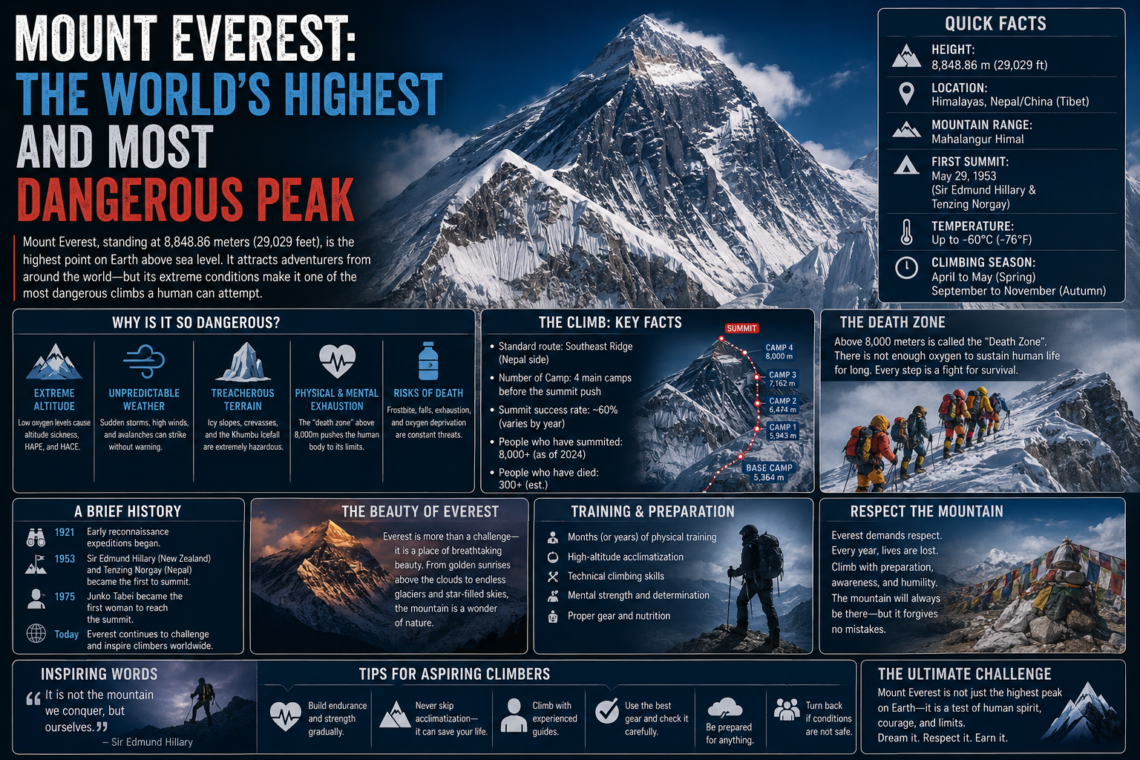
    Mount Everest is the tallest mountain on Earth, standing at 8,848.86 meters (29,031.7 feet) above sea level. Located in the Himalayas on the border between Nepal and Tibet (China), Everest represents the ultimate challenge for climbers worldwide.

    For many adventurers, reaching the summit of Everest is the achievement of a lifetime. However, it is also one of the most dangerous mountains in the world. Extreme weather, low oxygen levels, avalanches, and unpredictable conditions have claimed hundreds of lives.

    Mount Everest is a place of breathtaking beauty, extreme risk, and human determination.

    Where Is Mount Everest Located?

    Mount Everest is part of the Himalayan mountain range in South Asia. It sits directly on the border between Nepal and the Tibet Autonomous Region of China.

    The Nepalese side is the most popular route for climbers, beginning with a trek to Everest Base Camp. The Tibetan side also offers access but is more politically restricted.

    The mountain is known as:

    • Sagarmatha in Nepal
    • Chomolungma in Tibet

    Both names reflect deep cultural and spiritual significance.

    The Height of Everest

    Mount Everest’s official height was updated in 2020 to 8,848.86 meters after a joint survey by Nepal and China.

    At this altitude, the air contains about one-third of the oxygen available at sea level. This lack of oxygen creates life-threatening conditions for climbers.

    Above 8,000 meters lies what is known as the “Death Zone.”

    Why Is It Called the Death Zone?

    The Death Zone refers to altitudes above 8,000 meters where oxygen levels are insufficient to sustain human life for extended periods.

    In this zone:

    • The body begins to shut down
    • Decision-making becomes impaired
    • Frostbite risk increases dramatically
    • Exhaustion sets in quickly

    Climbers must move quickly through this area because prolonged exposure can be fatal.

    Even with supplemental oxygen, survival is not guaranteed.

    History of Climbing Everest

    The first successful summit of Mount Everest occurred on May 29, 1953. Sir Edmund Hillary of New Zealand and Tenzing Norgay, a Sherpa from Nepal, reached the top after years of failed attempts by others.

    Since then, thousands of climbers have attempted to reach the summit.

    While many have succeeded, over 300 climbers have died on Everest due to avalanches, falls, altitude sickness, and extreme weather.

    Some bodies remain on the mountain because recovery is too dangerous.

    The Dangers of Climbing Everest

    Climbing Mount Everest is not only physically demanding but extremely dangerous.

    Avalanches

    Large avalanches have killed multiple climbers in single events. The Khumbu Icefall, a section of moving glacier, is particularly risky.

    Extreme Weather

    Weather on Everest can change rapidly. Sudden storms bring high winds, freezing temperatures, and whiteout conditions.

    Altitude Sickness

    Lack of oxygen can cause:

    • High Altitude Pulmonary Edema (HAPE)
    • High Altitude Cerebral Edema (HACE)

    Both conditions can be fatal if not treated immediately.

    Traffic Jams

    In recent years, overcrowding during peak climbing season has created dangerous “traffic jams” near the summit. Climbers may wait in freezing temperatures, increasing risk of frostbite and oxygen depletion.

    The Role of Sherpas

    Sherpas are highly skilled Nepalese mountain guides who play a crucial role in Everest expeditions.

    They:

    • Fix ropes along climbing routes
    • Carry heavy equipment
    • Assist climbers during emergencies

    Sherpas often face the greatest risks, especially while navigating dangerous sections like the Khumbu Icefall.

    Their contribution is essential to the success of most Everest expeditions.

    The Cost of Climbing Everest

    Climbing Everest is expensive. Costs can range from $30,000 to over $100,000 depending on the level of support and logistics.

    Expenses include:

    • Government permits
    • Equipment
    • Oxygen tanks
    • Guides and Sherpa support
    • Travel and insurance

    Despite the high cost and risks, demand to climb Everest continues to grow.

    Environmental Concerns

    Mount Everest faces environmental challenges due to increased tourism.

    Issues include:

    • Trash left behind by climbers
    • Abandoned equipment
    • Human waste
    • Melting glaciers due to climate change

    Authorities have introduced rules requiring climbers to bring back a certain amount of waste.

    Preserving the mountain’s environment has become a major concern.

    Can Ordinary Tourists Visit Everest?

    While summiting Everest requires professional training, ordinary travelers can visit Everest Base Camp.

    The trek to Base Camp in Nepal is one of the most popular hiking routes in the world. It offers stunning views of Himalayan peaks without the extreme danger of summit climbing.

    Base Camp sits at approximately 5,364 meters and still requires physical preparation due to altitude.

    Why Everest Fascinates the World

    Mount Everest represents:

    • The ultimate human challenge
    • The pursuit of achievement
    • The power of nature
    • The limits of human endurance

    It attracts adventurers, scientists, photographers, and dreamers.

    For some, standing at the top of the world symbolizes personal triumph. For others, it raises ethical questions about risk, commercialization, and environmental impact.

    Final Thoughts

    Mount Everest is the highest mountain on Earth and one of the most dangerous. Its beauty is unmatched, yet its risks are severe.

    Climbing Everest requires courage, preparation, and respect for nature’s power. While not everyone can reach the summit, the mountain continues to inspire millions around the world.

    Everest is more than a peak — it is a symbol of ambition, resilience, and the human spirit’s desire to explore the unknown.

  • Death Valley, USA: The Hottest Place on Earth

    Death Valley, USA: The Hottest Place on Earth


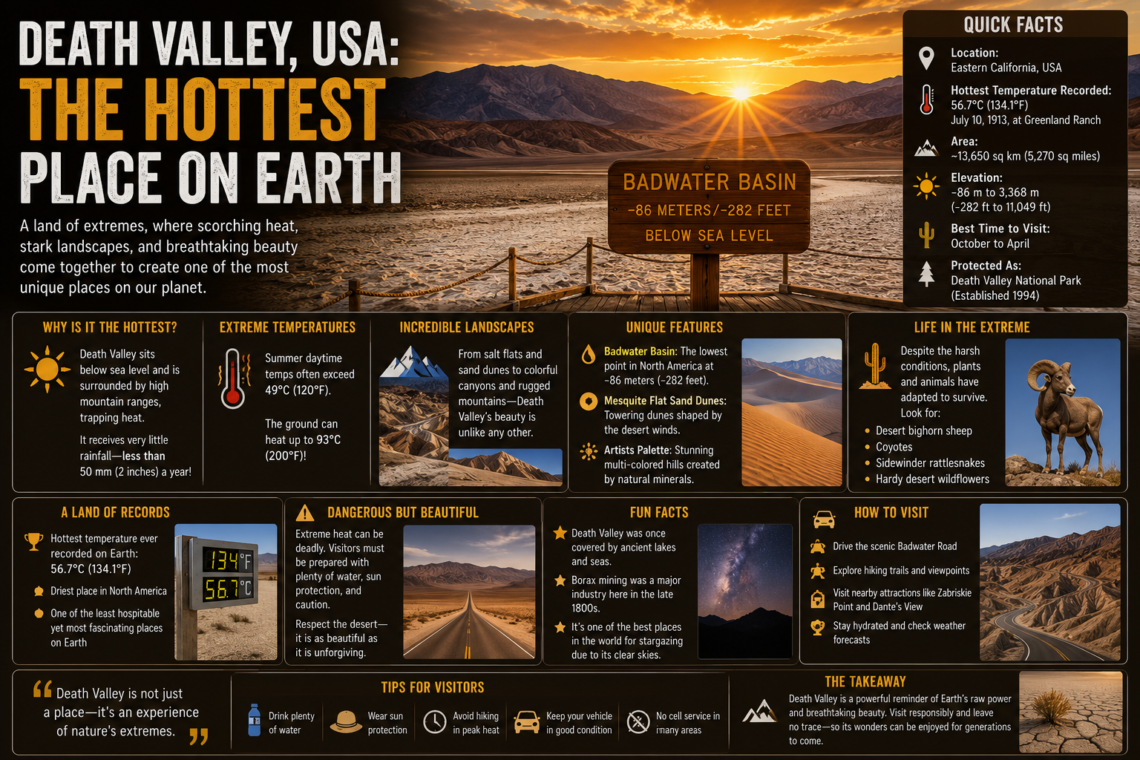
    Death Valley is one of the most extreme environments on the planet. Located in eastern California near the Nevada border, this vast desert landscape holds the record for the highest air temperature ever recorded on Earth. With its scorching heat, dry climate, and dramatic terrain, Death Valley is both breathtaking and dangerous.

    Despite its intimidating name, thousands of visitors travel here each year to experience its unique beauty.

    Where Is Death Valley Located?

    Death Valley lies within the Mojave Desert in the western United States. It stretches across approximately 3,000 square miles and is part of Death Valley National Park, one of the largest national parks in North America.

    The valley sits below sea level and is surrounded by high mountain ranges, which trap heat and create extreme temperatures.

    Why Is Death Valley So Hot?

    Death Valley’s extreme heat is caused by several geographic factors:

    • It lies below sea level, with Badwater Basin sitting at 282 feet below sea level.
    • Surrounding mountains trap hot air inside the valley.
    • The dry desert air prevents heat from escaping easily.
    • Clear skies allow intense sunlight to directly heat the ground.

    On July 10, 1913, Furnace Creek recorded a temperature of 56.7°C (134°F), widely recognized as the highest air temperature ever measured on Earth.

    Summer temperatures regularly exceed 45°C (113°F), making it one of the harshest climates for human survival.

    The Meaning Behind the Name

    Death Valley earned its name during the California Gold Rush in 1849. A group of pioneers attempting to cross the valley became trapped. Although most survived, one member reportedly died.

    As they finally escaped, a woman in the group is said to have turned back and said, “Goodbye, Death Valley,” giving the region its famous name.

    Is Death Valley Dangerous?

    Yes, Death Valley can be extremely dangerous, especially during summer.

    The primary risks include:

    • Severe dehydration
    • Heat exhaustion
    • Heatstroke
    • Vehicle breakdowns in remote areas

    Each year, emergency rescues are conducted for visitors who underestimate the heat.

    However, with proper planning and precautions, it is possible to explore the park safely.

    Unique Landscapes of Death Valley

    Despite its harsh climate, Death Valley is one of the most visually stunning desert landscapes in the world.

    Badwater Basin

    The lowest point in North America, Badwater Basin is covered in white salt flats that stretch across the desert floor. The geometric salt patterns create a surreal appearance.

    Mesquite Flat Sand Dunes

    These golden sand dunes offer classic desert scenery and are popular for photography, especially at sunrise and sunset.

    Zabriskie Point

    A famous viewpoint known for its colorful, eroded hills shaped by millions of years of geological activity.

    Artist’s Palette

    A hillside displaying vibrant colors caused by mineral deposits, including iron and manganese.

    Dante’s View

    From this high vantage point, visitors can look down at the entire valley floor, including Badwater Basin.

    Wildlife in Extreme Conditions

    Although it appears lifeless, Death Valley supports a surprising range of wildlife.

    Animals that survive here include:

    • Desert bighorn sheep
    • Coyotes
    • Lizards and snakes
    • Various bird species

    These animals have adapted to extreme temperatures by being active at night or seeking shelter during the hottest hours.

    Even certain plants manage to survive with minimal water.

    The Rare Super Bloom

    In rare years when rainfall conditions are ideal, Death Valley experiences a “super bloom.” During this phenomenon, wildflowers cover parts of the desert floor in bright colors.

    This transformation turns the normally dry landscape into a temporary sea of flowers, attracting photographers and nature lovers from around the world.

    Super blooms are unpredictable and may occur only once every several years.

    Visiting Death Valley Safely

    The best time to visit Death Valley is between November and March, when temperatures are mild and comfortable.

    Visitors are advised to:

    • Carry plenty of water
    • Avoid hiking during midday heat
    • Keep vehicles in good condition
    • Inform someone of travel plans in remote areas

    Cell service is limited in many parts of the park.

    With proper preparation, Death Valley can be explored safely and responsibly.

    Why Death Valley Fascinates Travelers

    Death Valley represents extremes. It holds records for heat, elevation, and dryness in North America.

    Travelers are drawn to:

    • Its dramatic desert scenery
    • Its geological formations
    • The thrill of visiting one of the hottest places on Earth
    • Its peaceful, remote atmosphere

    Unlike places that are dangerous due to conflict or wildlife, Death Valley’s challenge comes from nature itself.

    It demonstrates how life adapts to the harshest environments.

    The Contrast of Beauty and Danger

    What makes Death Valley unique is the contrast between beauty and danger.

    From glowing sunsets over sand dunes to vast salt flats shimmering under the sun, the landscape feels almost alien. Yet beneath this beauty lies one of the most unforgiving climates on the planet.

    The valley serves as a reminder of nature’s power and the importance of respecting extreme environments.

    Final Thoughts

    Death Valley, USA, is one of the most extraordinary and extreme destinations in the world. Known as the hottest place on Earth, it challenges human limits while offering unforgettable scenery.

    Though dangerous in summer, it remains a popular destination for travelers who prepare carefully.

    Death Valley proves that even in the harshest conditions, nature can create landscapes of remarkable beauty.


  • Chernobyl, Ukraine: Inside the World’s Worst Nuclear Disaster Zone

    Chernobyl, Ukraine: Inside the World’s Worst Nuclear Disaster Zone

    Chernobyl is one of the most infamous places in modern history. Located in northern Ukraine near the border with Belarus, it was the site of the world’s worst nuclear disaster in 1986. Today, Chernobyl stands as a haunting reminder of technological failure, human error, and the long-lasting consequences of radiation.

    What was once a thriving Soviet city is now an abandoned exclusion zone, frozen in time.

    What Happened at Chernobyl?

    On April 26, 1986, Reactor No. 4 at the Chernobyl Nuclear Power Plant exploded during a late-night safety test. A sudden power surge triggered a series of uncontrolled reactions, leading to a massive explosion.

    The explosion:

    • Destroyed the reactor core
    • Released large amounts of radioactive material into the atmosphere
    • Spread contamination across Ukraine, Belarus, Russia, and parts of Europe

    The disaster is classified as a Level 7 event on the International Nuclear Event Scale — the highest level possible.

    Why Did the Explosion Occur?

    The accident was caused by a combination of:

    • Flawed reactor design
    • Operator errors
    • Inadequate safety procedures

    The RBMK reactor used at Chernobyl had known design weaknesses. During the test, safety systems were disabled, and a sudden power spike led to catastrophic failure.

    The resulting explosion blew the 1,000-ton reactor lid off the building, exposing radioactive fuel to the environment.

    Immediate Impact of the Disaster

    Two plant workers died on the night of the explosion. In the following weeks, dozens of emergency responders and firefighters died from acute radiation sickness.

    Thousands of people were exposed to dangerous radiation levels.

    The nearby city of Pripyat, home to nearly 50,000 residents, was evacuated 36 hours after the explosion. Residents were told they would return in a few days. Most never returned.

    The Chernobyl Exclusion Zone

    After the disaster, a 30-kilometer exclusion zone was established around the plant. This area remains one of the most radioactive regions in the world.

    Entire towns and villages were abandoned. Buildings, schools, hospitals, and homes were left behind exactly as they were in 1986.

    Nature slowly reclaimed the land. Trees grew through buildings, and wildlife returned to areas once occupied by humans.

    Pripyat: The Ghost City

    Pripyat is perhaps the most haunting part of Chernobyl.

    Once a modern Soviet city, it featured:

    • Schools
    • Hospitals
    • Apartment buildings
    • An amusement park with a Ferris wheel

    The Ferris wheel, scheduled to open just days after the disaster, never operated. Today, it stands as a symbol of sudden abandonment.

    Walking through Pripyat feels like stepping back in time. Personal belongings, books, and furniture remain scattered across buildings.

    The Sarcophagus and New Safe Confinement

    After the explosion, Soviet authorities constructed a concrete structure known as the “sarcophagus” to contain the damaged reactor.

    Over time, the original structure weakened. In 2016, a massive steel arch called the New Safe Confinement was placed over the reactor to prevent further radiation leaks.

    This engineering project is one of the largest movable structures ever built.

    Radiation Levels Today

    Radiation levels in Chernobyl vary depending on location.

    Some areas remain highly contaminated and unsafe for long-term exposure. However, guided tours operate in certain zones where radiation levels are considered manageable for short visits.

    Visitors wear dosimeters to monitor exposure, and tours follow strict safety routes.

    Although short-term visits are generally considered safe under controlled conditions, the area is not suitable for permanent habitation.

    Environmental Impact

    The explosion released radioactive isotopes such as iodine-131 and cesium-137 into the atmosphere.

    The long-term effects included:

    • Increased thyroid cancer cases
    • Contaminated soil and water
    • Long-lasting ecological changes

    However, one unexpected outcome has been the return of wildlife. With human activity absent, species such as wolves, deer, and birds have flourished inside the exclusion zone.

    Some scientists consider it an unintended wildlife sanctuary.

    Can You Visit Chernobyl?

    Yes, Chernobyl was open to guided tours before regional conflicts disrupted tourism. Visitors could enter through authorized tour companies with strict regulations.

    Tours typically included:

    • The reactor site (viewed from a safe distance)
    • The ghost city of Pripyat
    • The Duga radar installation
    • Abandoned villages within the exclusion zone

    Travelers had to follow safety instructions carefully and avoid touching objects or entering restricted areas.

    Current travel conditions depend on political and security situations in Ukraine.

    Lessons from Chernobyl

    Chernobyl changed global nuclear policy. After the disaster:

    • Nuclear safety standards were strengthened worldwide
    • Reactor designs were improved
    • International cooperation on nuclear safety increased

    The accident exposed weaknesses in communication and transparency within the Soviet system.

    Chernobyl remains a powerful case study in engineering, risk management, and crisis response.

    Why Chernobyl Fascinates Travelers

    Chernobyl attracts attention because it combines:

    • Real historical tragedy
    • Abandoned urban landscapes
    • Scientific importance
    • Human stories of sacrifice and survival

    Unlike mythical or exaggerated locations, Chernobyl’s danger was real and documented.

    Its silent streets and decaying buildings serve as a reminder of how quickly civilization can collapse under extreme circumstances.

    Final Thoughts

    Chernobyl is more than a disaster site. It is a symbol of human error, resilience, and the lasting impact of technological failure.

    The abandoned city of Pripyat and the damaged reactor stand as reminders of a night that changed history forever.

    For those interested in history, science, and extreme destinations, Chernobyl remains one of the most powerful and thought-provoking places on Earth.


  • The Door to Hell: Turkmenistan’s Burning Crater That Has Been on Fire for Over 50 Years

    The Door to Hell: Turkmenistan’s Burning Crater That Has Been on Fire for Over 50 Years


    In the middle of the Karakum Desert in Turkmenistan lies one of the most surreal and dramatic sights on Earth — a massive fiery crater known as the “Door to Hell.” Officially called the Darvaza Gas Crater, this enormous pit has been burning continuously since 1971.

    What was once a scientific accident has become one of the world’s most unusual travel attractions. The glowing flames, visible from miles away at night, create a scene that looks almost otherworldly.

    Where Is the Door to Hell Located?

    The Darvaza Gas Crater is located in the Karakum Desert of Turkmenistan, about 260 kilometers north of the capital city, Ashgabat. The Karakum Desert covers nearly 70% of the country and is rich in natural gas reserves.

    The crater itself is approximately:

    • 70 meters wide
    • 30 meters deep

    Its massive size and constant flames make it one of the most striking man-made disasters still active today.

    How Did the Door to Hell Begin?

    The story of the crater dates back to 1971 during the Soviet era. Soviet geologists were drilling for natural gas when their rig accidentally collapsed into an underground cavern filled with methane gas.

    The ground beneath the drilling platform gave way, forming a large crater. Fearing that the methane gas release could spread and harm nearby communities, scientists decided to ignite the gas. They believed the fire would burn out in a few days.

    However, the flames have continued burning for more than five decades.

    The constant supply of natural gas feeding the fire has kept the crater alive, turning it into a permanent fiery landmark.

    Why Is It Called the Door to Hell?

    The nickname “Door to Hell” comes from the crater’s appearance. At night, the intense orange glow from the flames lights up the desert sky. The roaring sound of burning gas and the extreme heat add to its dramatic effect.

    Standing at the edge of the crater feels surreal. The combination of fire, heat, and desert isolation creates an atmosphere that seems almost apocalyptic.

    Is It Dangerous?

    Yes, the Darvaza Gas Crater can be dangerous.

    The risks include:

    • Extreme heat near the edge
    • Risk of falling into the crater
    • Toxic gases in the surrounding area
    • Harsh desert conditions

    The Karakum Desert experiences very high temperatures during the day and cold temperatures at night. Visitors must travel with experienced guides and proper equipment.

    Although tourists are allowed to visit, safety precautions are essential.

    Can You Visit the Door to Hell?

    Unlike many dangerous places on Earth, the Door to Hell is accessible to tourists. However, reaching it is not easy.

    There are no paved roads directly leading to the crater. Visitors usually travel by off-road vehicles across desert terrain. Most tours include camping overnight to witness the crater glowing after sunset.

    Tourism in Turkmenistan is tightly regulated, and travelers often need a visa and guided tour arrangements in advance.

    Despite these challenges, adventurous travelers consider it one of the most unique destinations in Central Asia.

    Environmental Concerns

    The crater continuously releases methane and other gases into the atmosphere. Methane is a powerful greenhouse gas that contributes to climate change.

    Over the years, Turkmenistan’s government has discussed plans to extinguish the fire. However, completely sealing or stopping the gas flow is technically complex and expensive.

    As of now, the flames continue to burn.

    The Science Behind the Flames

    Natural gas is primarily composed of methane. When ignited, methane burns with a blue or orange flame depending on oxygen levels and impurities.

    The constant fuel supply beneath the crater keeps the fire alive. Since the underground gas reservoir has not been fully depleted, the burning continues without interruption.

    The crater essentially acts as a massive open gas vent.

    Why the Door to Hell Fascinates the World

    The Darvaza Gas Crater captures global attention for several reasons:

    • It represents human error in industrial exploration
    • It demonstrates the power of natural gas reserves
    • It creates a visually dramatic and rare phenomenon
    • It combines science, danger, and mystery

    In a world filled with natural wonders, the Door to Hell stands out because it is partly man-made.

    It serves as a reminder of how industrial accidents can create unexpected landmarks.

    Comparing the Door to Hell to Other Extreme Destinations

    Unlike volcanic craters, the Darvaza crater was not formed by natural geological processes alone. It is a result of human activity interacting with natural gas reserves.

    Compared to places like Chernobyl or Snake Island, the Door to Hell is more accessible and less politically restricted. However, it still requires caution and planning.

    Its remote desert setting adds to its appeal for adventure travelers.

    The Future of the Crater

    Turkmenistan’s government has announced interest in closing the crater to prevent environmental damage. If this happens, one of the world’s strangest attractions may eventually disappear.

    Until then, the flames continue to burn, drawing photographers, explorers, and curious travelers from around the world.

    Final Thoughts

    The Door to Hell in Turkmenistan is one of the most unusual and dramatic destinations on Earth. Born from a scientific drilling accident in 1971, it has transformed into a fiery symbol of nature’s power and human miscalculation.

    Glowing endlessly in the heart of the desert, the Darvaza Gas Crater remains a reminder that some of the world’s most fascinating places are created by unexpected events.

    For travelers seeking rare and extreme destinations, the Door to Hell offers a sight unlike any other — a burning crater that has defied expectations for over 50 years.


  • Area 51: America’s Most Secretive Military Base and the World’s Biggest Mystery

    Area 51: America’s Most Secretive Military Base and the World’s Biggest Mystery


    Area 51 is one of the most mysterious and controversial locations in the world. Located in the Nevada desert in the United States, this highly classified military facility has fueled conspiracy theories, alien rumors, and government secrecy debates for decades.

    Unlike famous tourist attractions, Area 51 is not open to the public. It is heavily guarded, restricted, and surrounded by warning signs that clearly state that deadly force is authorized against trespassers. Despite this, it remains one of the most searched and discussed locations on the internet.

    Where Is Area 51 Located?

    Area 51 is situated in southern Nevada, about 135 kilometers northwest of Las Vegas. It lies within the Nevada Test and Training Range, a large military-controlled area used for weapons testing and training.

    The base is located near Groom Lake, a dry lakebed that serves as a natural runway. Because of its remote desert location, the area provides secrecy, security, and controlled airspace — ideal conditions for military experiments.

    What Is Area 51 Used For?

    Officially, Area 51 is a U.S. Air Force facility used for testing experimental aircraft and advanced military technology.

    During the Cold War, the base played a critical role in developing spy planes such as:

    • The U-2 reconnaissance aircraft
    • The SR-71 Blackbird
    • Stealth fighter jets

    These aircraft were tested in secrecy to maintain a technological advantage over rival nations.

    The U.S. government did not officially acknowledge the existence of Area 51 until 2013, when declassified CIA documents confirmed its role in aircraft testing.

    Why Is Area 51 So Secret?

    The primary reason for secrecy is national security. Advanced military technologies must remain confidential to prevent foreign adversaries from gaining access to sensitive information.

    However, government secrecy has also led to widespread speculation.

    Because unusual aircraft were tested in the sky above Nevada during the 1950s and 1960s, many people mistook them for UFOs. This misunderstanding helped create the strong association between Area 51 and alien activity.

    The Alien Conspiracy Theories

    Area 51 is most famous for its connection to extraterrestrial conspiracy theories.

    Many believe that:

    • The U.S. government stores crashed alien spacecraft at Area 51
    • Alien bodies are hidden inside underground laboratories
    • Secret experiments are conducted with extraterrestrial technology

    These theories became popular after the 1947 Roswell incident in New Mexico, where debris from a crashed object was recovered. While the government later stated it was a weather balloon, conspiracy theorists believe it was an alien spacecraft — and that the wreckage was transported to Area 51.

    Despite decades of rumors, there is no verified evidence that aliens are stored or studied at the base.

    Security Around Area 51

    Security at Area 51 is extremely strict.

    The perimeter is marked with:

    • Warning signs
    • Surveillance cameras
    • Motion sensors
    • Armed patrol units

    The guards are sometimes referred to as “camo dudes” because they wear camouflage and monitor the area from hidden positions.

    The airspace above Area 51 is also restricted. Unauthorized aircraft are not allowed to enter.

    Trespassing can result in heavy fines, arrest, or serious consequences.

    Can You Visit Area 51?

    You cannot legally enter Area 51 itself. However, tourists can visit nearby locations.

    The small town of Rachel, Nevada, is the closest settlement to the base. It has become a tourist stop for UFO enthusiasts. The famous “Extraterrestrial Highway” (Nevada State Route 375) attracts visitors hoping to spot unusual lights in the sky.

    In 2019, a viral social media event called “Storm Area 51” encouraged people to raid the base to “see the aliens.” Although millions expressed interest online, only a small number showed up, and no one successfully entered the facility.

    Why Area 51 Fascinates the World

    Area 51 represents more than just a military base. It symbolizes:

    • Government secrecy
    • Advanced hidden technology
    • Human curiosity about extraterrestrial life
    • The unknown

    In an age where most of the world is mapped and documented, places that remain secret naturally attract attention.

    The idea that something extraordinary could be hidden behind guarded gates keeps the mystery alive.

    The Reality Behind the Mystery

    While alien stories dominate headlines, experts agree that Area 51’s primary purpose is military research and development.

    The strange sightings reported over the years were likely advanced aircraft being tested before public knowledge.

    For example, stealth aircraft appeared unusual and futuristic before their existence was officially announced.

    The combination of classified projects and public imagination created the legend of Area 51.

    Ethical and Political Questions

    Area 51 also raises broader questions:

    • How much secrecy is necessary for national security?
    • Should governments disclose more information to the public?
    • Where is the balance between transparency and protection?

    These debates continue, especially in democratic societies where citizens demand accountability.

    Final Thoughts

    Area 51 remains one of the most mysterious locations in the world. Whether viewed as a top-secret military base or the center of alien conspiracy theories, it continues to capture global imagination.

    While you cannot enter the facility, its legend has made it one of the most famous restricted areas on Earth.

    In the end, Area 51 teaches us something important — sometimes secrecy creates more fascination than truth ever could.