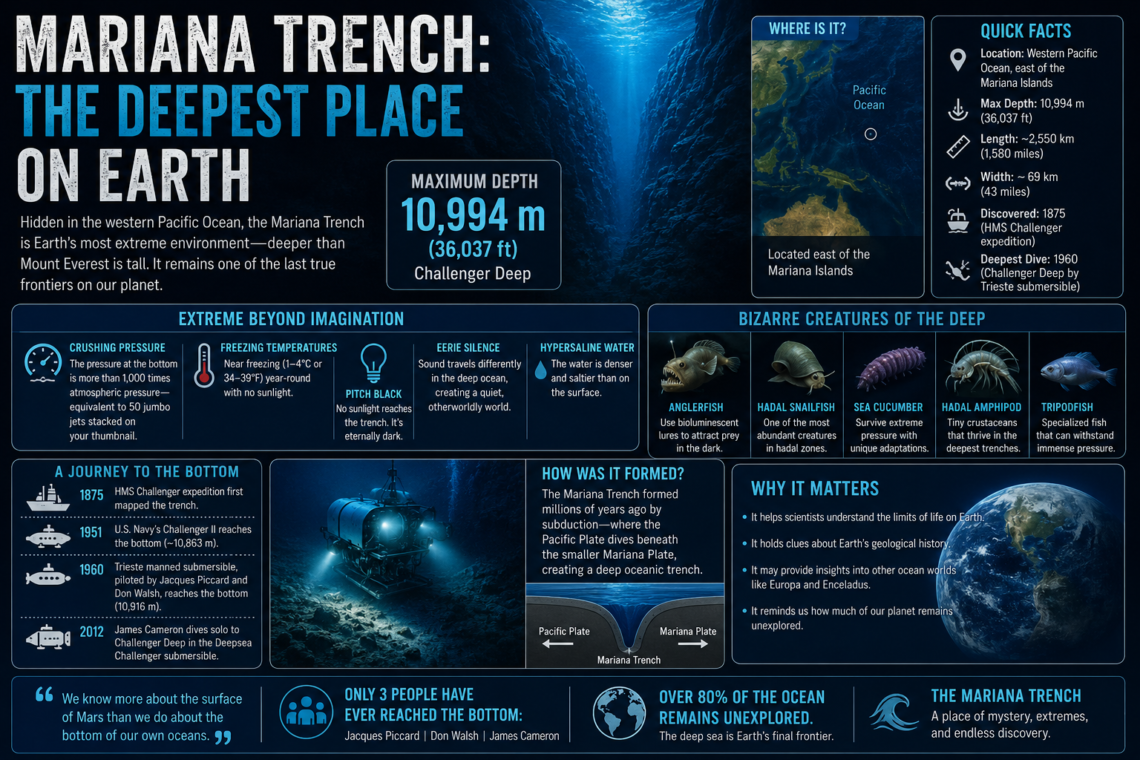
The Mariana Trench is the deepest part of the world’s oceans, a place so extreme and remote that it remains largely unexplored. Located in the western Pacific Ocean, east of the Mariana Islands, this underwater canyon plunges to incredible depths, far beyond what most humans can experience.
It is a place of mystery, danger, and scientific fascination, offering insights into the planet’s geology, oceanography, and life under extreme conditions.
Where Is the Mariana Trench Located?
The Mariana Trench stretches over 2,550 kilometers (1,580 miles) and is about 69 kilometers (43 miles) wide at its widest point. Its deepest section is known as the Challenger Deep, which reaches approximately 10,935 meters (35,876 feet) — nearly 11 kilometers below sea level.
This depth is so extreme that Mount Everest could easily fit inside the trench, with its peak still submerged under more than a kilometer of water.
The trench lies in the Pacific Ocean, east of the Mariana Islands and near Guam. Its location is remote, making exploration logistically challenging and expensive.
How Was the Trench Formed?
The Mariana Trench is a subduction zone, formed where two tectonic plates collide. The Pacific Plate is being forced beneath the Mariana Plate, creating a deep, narrow canyon on the ocean floor.
This geological process produces extreme pressures, intense seismic activity, and unusual underwater landscapes, including ridges, cliffs, and deep basins.
Life in the Mariana Trench
Despite its extreme conditions — crushing pressures over 1,000 times that at sea level, near-freezing temperatures, and total darkness — life exists in the trench.
Adapted species include:
- Giant amoebas that survive on microscopic organisms
- Deep-sea amphipods (shrimp-like creatures)
- Snailfish that withstand extreme pressure
- Bacteria and microorganisms that live off chemical reactions in the rocks
These organisms have evolved unique adaptations, such as flexible cell membranes and specialized enzymes, allowing survival under enormous pressure and low light conditions.
Human Exploration
Exploring the Mariana Trench is extremely difficult due to depth and pressure. Few humans have ever descended to the Challenger Deep.
Notable Expeditions
- 1960 – Trieste Submersible: Jacques Piccard and Don Walsh reached the bottom in a bathyscaphe, marking the first manned descent.
- 2012 – James Cameron: The filmmaker and explorer made a solo dive in the Deepsea Challenger, capturing footage of previously unseen marine life.
- Recent Expeditions: Modern unmanned submersibles and robotic vehicles continue to explore and map the trench.
These explorations reveal unique life forms, extreme geological features, and underwater ecosystems unlike anywhere else on Earth.
Why Is the Mariana Trench Dangerous?
The trench’s extreme conditions make it inherently dangerous for human exploration:
- Crushing pressure: At the deepest point, pressure is over 1,000 atmospheres — enough to crush conventional submarines.
- Freezing temperatures: Water temperatures hover near 1–4°C (34–39°F).
- Total darkness: Sunlight cannot penetrate these depths.
- Limited technology: Specialized submersibles are required, and even these are at risk of failure.
Because of these factors, only highly trained explorers using state-of-the-art equipment can visit safely.
Scientific Importance
The Mariana Trench provides critical insights into:
- Plate tectonics and geology – Understanding subduction zones helps predict earthquakes and tsunamis.
- Extreme biology – Organisms living here offer clues about adaptation, evolution, and potential life on other planets.
- Climate history – Sediment samples reveal Earth’s past climate and ocean conditions.
Studying the trench helps scientists understand the planet’s most extreme environments and the resilience of life.
Myths and Popular Culture
The Mariana Trench has inspired countless legends, including:
- Stories of giant sea monsters
- Hidden cities or ancient civilizations
- The trench as a “gateway to the underworld”
Movies, documentaries, and books often exaggerate the dangers, but its real-life extremes are already astonishing enough.
Visiting the Mariana Trench
Unlike a typical travel destination, the trench cannot be visited by ordinary tourists. Access is limited to researchers and explorers in specially designed submarines.
However, people can experience the area virtually through:
- Deep-sea footage from expeditions
- Documentaries and interactive maps
- Research centers and museums displaying trench discoveries
For most, learning about it through media is the only feasible way to “visit.”
Why the Mariana Trench Fascinates the World
The trench symbolizes:
- The unknown and unexplored frontiers of Earth
- Human curiosity and the desire to conquer extreme environments
- The fragility and adaptability of life under extreme conditions
Its mystery, beauty, and danger continue to captivate scientists, adventurers, and the general public alike.
Final Thoughts
The Mariana Trench is a realm unlike any other on Earth — dark, deep, and deadly. Its extreme pressure, unique life forms, and geological wonders make it one of the most fascinating locations on the planet.
While few humans will ever descend to its depths, the trench remains a symbol of the limits of exploration, the resilience of life, and the vast mysteries that still exist on our own planet.