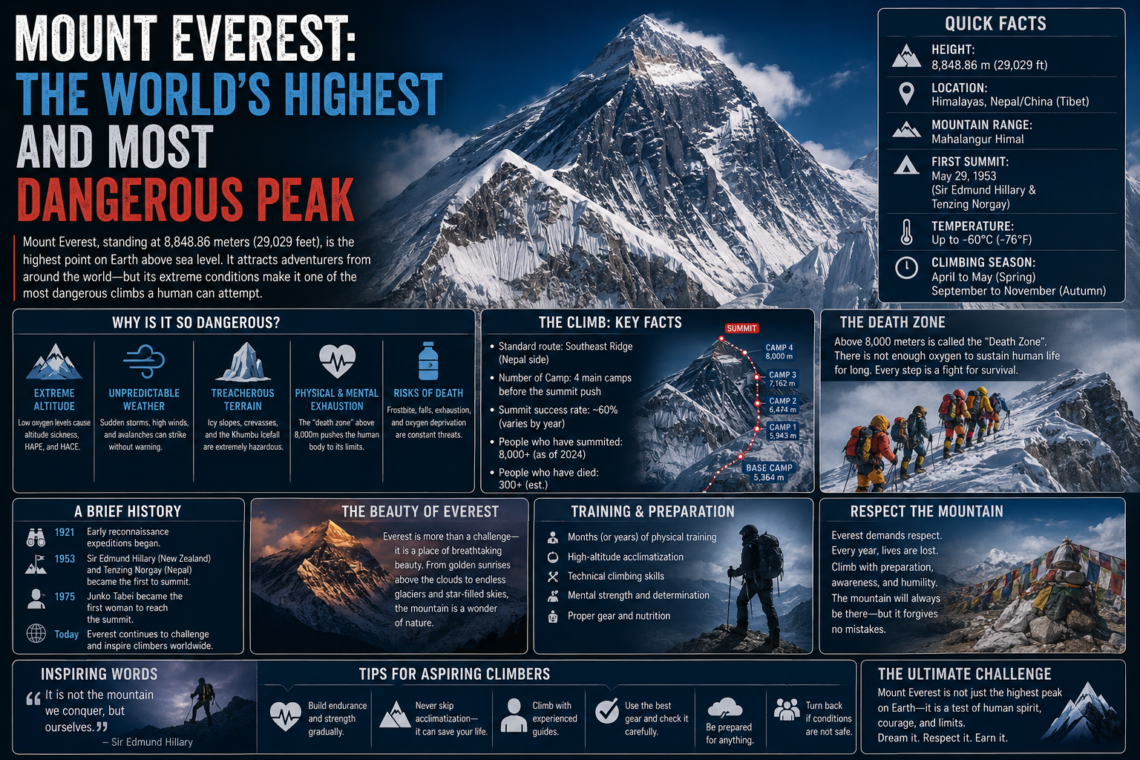
Mount Everest is the tallest mountain on Earth, standing at 8,848.86 meters (29,031.7 feet) above sea level. Located in the Himalayas on the border between Nepal and Tibet (China), Everest represents the ultimate challenge for climbers worldwide.
For many adventurers, reaching the summit of Everest is the achievement of a lifetime. However, it is also one of the most dangerous mountains in the world. Extreme weather, low oxygen levels, avalanches, and unpredictable conditions have claimed hundreds of lives.
Mount Everest is a place of breathtaking beauty, extreme risk, and human determination.
Where Is Mount Everest Located?
Mount Everest is part of the Himalayan mountain range in South Asia. It sits directly on the border between Nepal and the Tibet Autonomous Region of China.
The Nepalese side is the most popular route for climbers, beginning with a trek to Everest Base Camp. The Tibetan side also offers access but is more politically restricted.
The mountain is known as:
- Sagarmatha in Nepal
- Chomolungma in Tibet
Both names reflect deep cultural and spiritual significance.
The Height of Everest
Mount Everest’s official height was updated in 2020 to 8,848.86 meters after a joint survey by Nepal and China.
At this altitude, the air contains about one-third of the oxygen available at sea level. This lack of oxygen creates life-threatening conditions for climbers.
Above 8,000 meters lies what is known as the “Death Zone.”
Why Is It Called the Death Zone?
The Death Zone refers to altitudes above 8,000 meters where oxygen levels are insufficient to sustain human life for extended periods.
In this zone:
- The body begins to shut down
- Decision-making becomes impaired
- Frostbite risk increases dramatically
- Exhaustion sets in quickly
Climbers must move quickly through this area because prolonged exposure can be fatal.
Even with supplemental oxygen, survival is not guaranteed.
History of Climbing Everest
The first successful summit of Mount Everest occurred on May 29, 1953. Sir Edmund Hillary of New Zealand and Tenzing Norgay, a Sherpa from Nepal, reached the top after years of failed attempts by others.
Since then, thousands of climbers have attempted to reach the summit.
While many have succeeded, over 300 climbers have died on Everest due to avalanches, falls, altitude sickness, and extreme weather.
Some bodies remain on the mountain because recovery is too dangerous.
The Dangers of Climbing Everest
Climbing Mount Everest is not only physically demanding but extremely dangerous.
Avalanches
Large avalanches have killed multiple climbers in single events. The Khumbu Icefall, a section of moving glacier, is particularly risky.
Extreme Weather
Weather on Everest can change rapidly. Sudden storms bring high winds, freezing temperatures, and whiteout conditions.
Altitude Sickness
Lack of oxygen can cause:
- High Altitude Pulmonary Edema (HAPE)
- High Altitude Cerebral Edema (HACE)
Both conditions can be fatal if not treated immediately.
Traffic Jams
In recent years, overcrowding during peak climbing season has created dangerous “traffic jams” near the summit. Climbers may wait in freezing temperatures, increasing risk of frostbite and oxygen depletion.
The Role of Sherpas
Sherpas are highly skilled Nepalese mountain guides who play a crucial role in Everest expeditions.
They:
- Fix ropes along climbing routes
- Carry heavy equipment
- Assist climbers during emergencies
Sherpas often face the greatest risks, especially while navigating dangerous sections like the Khumbu Icefall.
Their contribution is essential to the success of most Everest expeditions.
The Cost of Climbing Everest
Climbing Everest is expensive. Costs can range from $30,000 to over $100,000 depending on the level of support and logistics.
Expenses include:
- Government permits
- Equipment
- Oxygen tanks
- Guides and Sherpa support
- Travel and insurance
Despite the high cost and risks, demand to climb Everest continues to grow.
Environmental Concerns
Mount Everest faces environmental challenges due to increased tourism.
Issues include:
- Trash left behind by climbers
- Abandoned equipment
- Human waste
- Melting glaciers due to climate change
Authorities have introduced rules requiring climbers to bring back a certain amount of waste.
Preserving the mountain’s environment has become a major concern.
Can Ordinary Tourists Visit Everest?
While summiting Everest requires professional training, ordinary travelers can visit Everest Base Camp.
The trek to Base Camp in Nepal is one of the most popular hiking routes in the world. It offers stunning views of Himalayan peaks without the extreme danger of summit climbing.
Base Camp sits at approximately 5,364 meters and still requires physical preparation due to altitude.
Why Everest Fascinates the World
Mount Everest represents:
- The ultimate human challenge
- The pursuit of achievement
- The power of nature
- The limits of human endurance
It attracts adventurers, scientists, photographers, and dreamers.
For some, standing at the top of the world symbolizes personal triumph. For others, it raises ethical questions about risk, commercialization, and environmental impact.
Final Thoughts
Mount Everest is the highest mountain on Earth and one of the most dangerous. Its beauty is unmatched, yet its risks are severe.
Climbing Everest requires courage, preparation, and respect for nature’s power. While not everyone can reach the summit, the mountain continues to inspire millions around the world.
Everest is more than a peak — it is a symbol of ambition, resilience, and the human spirit’s desire to explore the unknown.