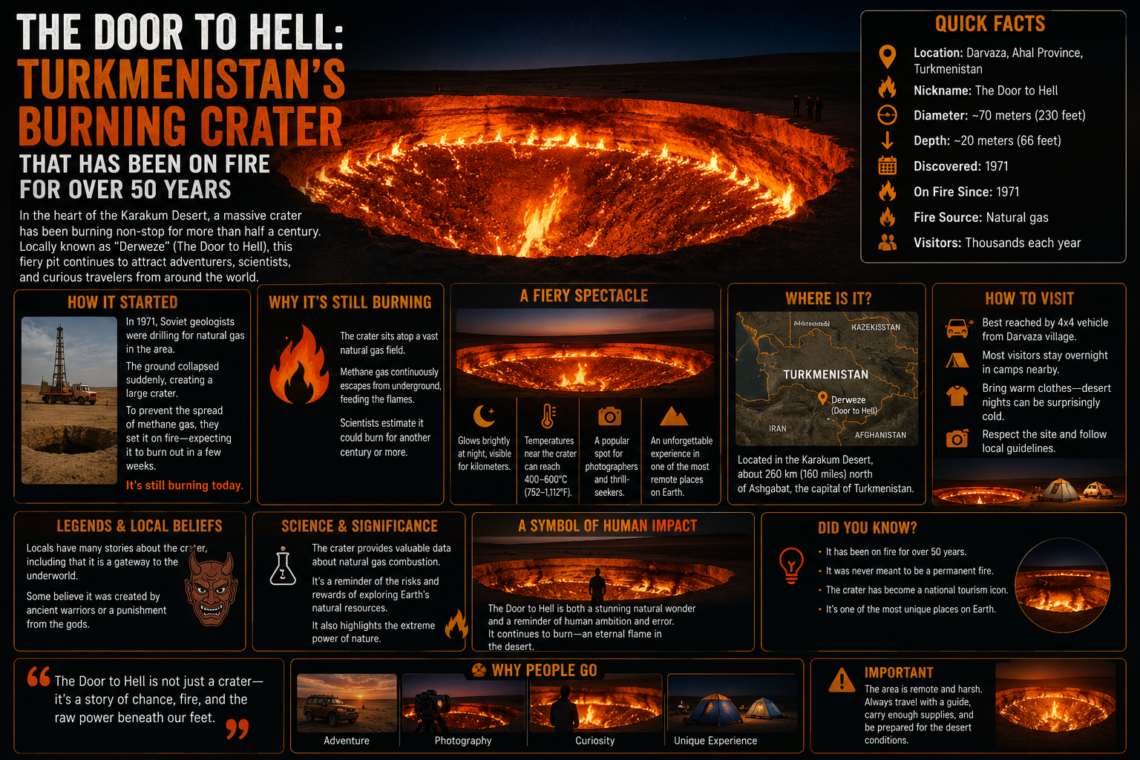
In the middle of the Karakum Desert in Turkmenistan lies one of the most surreal and dramatic sights on Earth — a massive fiery crater known as the “Door to Hell.” Officially called the Darvaza Gas Crater, this enormous pit has been burning continuously since 1971.
What was once a scientific accident has become one of the world’s most unusual travel attractions. The glowing flames, visible from miles away at night, create a scene that looks almost otherworldly.
Where Is the Door to Hell Located?
The Darvaza Gas Crater is located in the Karakum Desert of Turkmenistan, about 260 kilometers north of the capital city, Ashgabat. The Karakum Desert covers nearly 70% of the country and is rich in natural gas reserves.
The crater itself is approximately:
- 70 meters wide
- 30 meters deep
Its massive size and constant flames make it one of the most striking man-made disasters still active today.
How Did the Door to Hell Begin?
The story of the crater dates back to 1971 during the Soviet era. Soviet geologists were drilling for natural gas when their rig accidentally collapsed into an underground cavern filled with methane gas.
The ground beneath the drilling platform gave way, forming a large crater. Fearing that the methane gas release could spread and harm nearby communities, scientists decided to ignite the gas. They believed the fire would burn out in a few days.
However, the flames have continued burning for more than five decades.
The constant supply of natural gas feeding the fire has kept the crater alive, turning it into a permanent fiery landmark.
Why Is It Called the Door to Hell?
The nickname “Door to Hell” comes from the crater’s appearance. At night, the intense orange glow from the flames lights up the desert sky. The roaring sound of burning gas and the extreme heat add to its dramatic effect.
Standing at the edge of the crater feels surreal. The combination of fire, heat, and desert isolation creates an atmosphere that seems almost apocalyptic.
Is It Dangerous?
Yes, the Darvaza Gas Crater can be dangerous.
The risks include:
- Extreme heat near the edge
- Risk of falling into the crater
- Toxic gases in the surrounding area
- Harsh desert conditions
The Karakum Desert experiences very high temperatures during the day and cold temperatures at night. Visitors must travel with experienced guides and proper equipment.
Although tourists are allowed to visit, safety precautions are essential.
Can You Visit the Door to Hell?
Unlike many dangerous places on Earth, the Door to Hell is accessible to tourists. However, reaching it is not easy.
There are no paved roads directly leading to the crater. Visitors usually travel by off-road vehicles across desert terrain. Most tours include camping overnight to witness the crater glowing after sunset.
Tourism in Turkmenistan is tightly regulated, and travelers often need a visa and guided tour arrangements in advance.
Despite these challenges, adventurous travelers consider it one of the most unique destinations in Central Asia.
Environmental Concerns
The crater continuously releases methane and other gases into the atmosphere. Methane is a powerful greenhouse gas that contributes to climate change.
Over the years, Turkmenistan’s government has discussed plans to extinguish the fire. However, completely sealing or stopping the gas flow is technically complex and expensive.
As of now, the flames continue to burn.
The Science Behind the Flames
Natural gas is primarily composed of methane. When ignited, methane burns with a blue or orange flame depending on oxygen levels and impurities.
The constant fuel supply beneath the crater keeps the fire alive. Since the underground gas reservoir has not been fully depleted, the burning continues without interruption.
The crater essentially acts as a massive open gas vent.
Why the Door to Hell Fascinates the World
The Darvaza Gas Crater captures global attention for several reasons:
- It represents human error in industrial exploration
- It demonstrates the power of natural gas reserves
- It creates a visually dramatic and rare phenomenon
- It combines science, danger, and mystery
In a world filled with natural wonders, the Door to Hell stands out because it is partly man-made.
It serves as a reminder of how industrial accidents can create unexpected landmarks.
Comparing the Door to Hell to Other Extreme Destinations
Unlike volcanic craters, the Darvaza crater was not formed by natural geological processes alone. It is a result of human activity interacting with natural gas reserves.
Compared to places like Chernobyl or Snake Island, the Door to Hell is more accessible and less politically restricted. However, it still requires caution and planning.
Its remote desert setting adds to its appeal for adventure travelers.
The Future of the Crater
Turkmenistan’s government has announced interest in closing the crater to prevent environmental damage. If this happens, one of the world’s strangest attractions may eventually disappear.
Until then, the flames continue to burn, drawing photographers, explorers, and curious travelers from around the world.
Final Thoughts
The Door to Hell in Turkmenistan is one of the most unusual and dramatic destinations on Earth. Born from a scientific drilling accident in 1971, it has transformed into a fiery symbol of nature’s power and human miscalculation.
Glowing endlessly in the heart of the desert, the Darvaza Gas Crater remains a reminder that some of the world’s most fascinating places are created by unexpected events.
For travelers seeking rare and extreme destinations, the Door to Hell offers a sight unlike any other — a burning crater that has defied expectations for over 50 years.