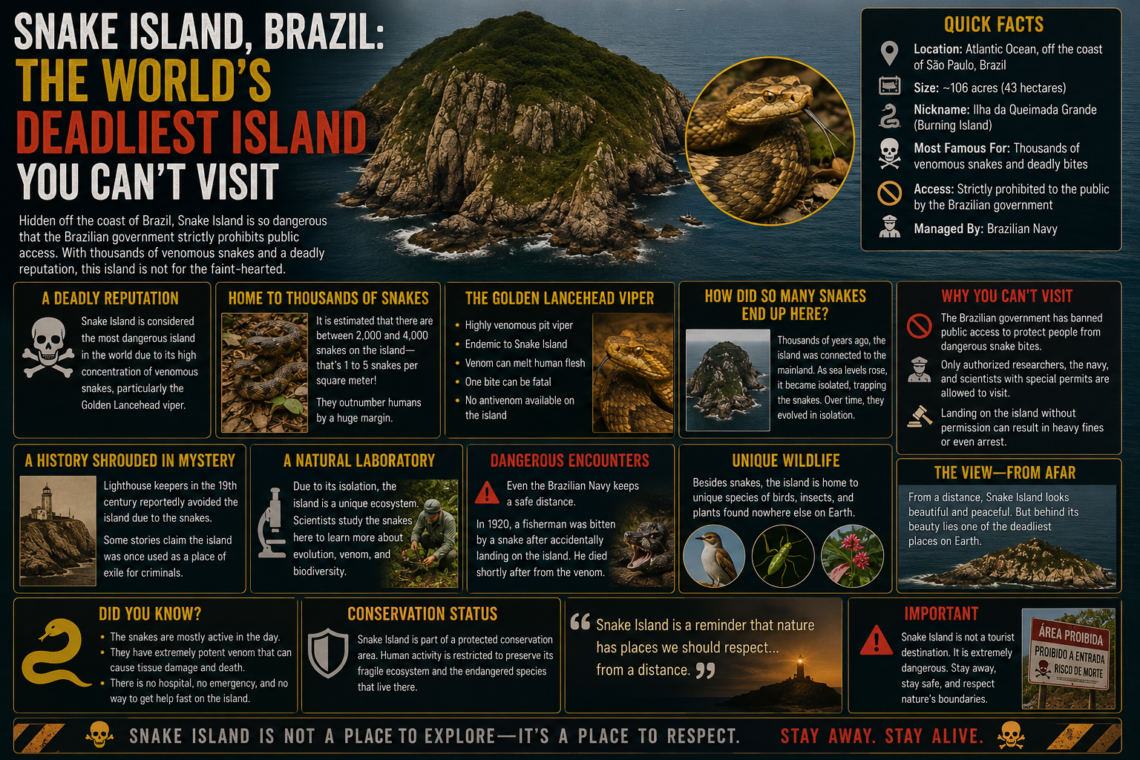
Snake Island, officially known as Ilha da Queimada Grande, is one of the most dangerous islands in the world. Located about 33 kilometers off the coast of Brazil, this island is home to thousands of venomous snakes, particularly the critically endangered Golden Lancehead Viper.
Why Is Snake Island So Dangerous?
The Golden Lancehead is one of the most venomous snakes in the world. Its venom can melt human flesh and cause rapid tissue destruction. Some estimates suggest there may be one snake per square meter in certain areas of the island.
Due to extreme danger, the Brazilian government has strictly prohibited public access to the island. Only authorized researchers are allowed to visit under special permits.
Why So Many Snakes?
Thousands of years ago, rising sea levels separated the island from mainland Brazil. The snakes became isolated and evolved without predators. With plenty of birds as prey and no natural enemies, their population grew rapidly.
Can You Visit?
No. Visiting Snake Island is illegal without government permission.
Snake Island remains one of the most fascinating yet terrifying places on Earth.
3. Area 51, United States
Area 51 is one of the most secretive military bases in the world. Located in Nevada, USA, it has fueled conspiracy theories for decades.
What Happens at Area 51?
Officially, Area 51 is a highly classified U.S. Air Force facility used for testing experimental aircraft. However, many believe it houses alien technology and UFO evidence.
The U-2 spy plane and stealth aircraft were reportedly tested here.
Why Is It Restricted?
The base is heavily guarded. Warning signs clearly state that deadly force is authorized for trespassers.
Why It Fascinates Travelers
While you cannot enter Area 51, many tourists visit nearby Rachel, Nevada, hoping to glimpse something unusual.
Area 51 represents mystery, secrecy, and the unknown.
4. The Door to Hell, Turkmenistan
The Darvaza Gas Crater, known as the Door to Hell, has been burning continuously since 1971.
How Did It Start?
Soviet engineers accidentally drilled into a gas pocket. To prevent methane poisoning, they set it on fire — expecting it to burn out in days. It has been burning for over 50 years.
What Makes It Unique?
The massive crater glows intensely at night, creating a dramatic and surreal sight in the Karakum Desert.
It is dangerous but accessible through guided tours.
5. Chernobyl, Ukraine
Chernobyl is the site of the worst nuclear disaster in history, which occurred in 1986.
What Happened?
Reactor 4 exploded, releasing radioactive material across Europe.
Can You Visit?
Yes, but only through guided tours. Certain zones remain highly radioactive.
Chernobyl stands as a powerful reminder of technological risks and human error.
6. Death Valley, USA
Death Valley is one of the hottest places on Earth.
Why Is It Dangerous?
Temperatures have reached 56.7°C (134°F). Dehydration and heatstroke are serious risks.
Despite harsh conditions, it attracts thousands of visitors annually due to its unique desert landscape.
7. Mount Everest, Nepal
Mount Everest is the highest mountain in the world at 8,848 meters.
Why Is It Dangerous?
Extreme altitude, avalanches, and lack of oxygen make it deadly. Over 300 climbers have died attempting to reach the summit.
Everest represents ultimate adventure and risk.
8. Lake Natron, Tanzania
Lake Natron is known for turning animals into stone-like statues.
Why?
The lake contains high levels of alkaline salt and minerals. Its water temperature can reach 60°C.
It is visually stunning but extremely harsh.
9. Bermuda Triangle
Located between Florida, Bermuda, and Puerto Rico, this area is famous for mysterious disappearances.
While science explains many incidents through weather and navigation errors, the mystery remains popular in travel discussions.
10. Mariana Trench
The deepest part of the ocean, reaching nearly 11,000 meters.
Extreme pressure makes it nearly impossible for humans to explore.
Only a few expeditions have reached the bottom.
11. Pripyat, Ukraine
Abandoned after the Chernobyl disaster, Pripyat is now a ghost city.
Empty schools, ferris wheels, and buildings create an eerie atmosphere.
12. Danakil Depression, Ethiopia
One of the hottest and most inhospitable places on Earth.
Acid pools, volcanic activity, and extreme heat make it dangerous but fascinating.
13. Jacob’s Well, Texas
A beautiful but deadly underwater cave.
Many divers have lost their lives exploring its narrow underwater passages.
14. Mount Sinabung, Indonesia
An active volcano that has erupted multiple times in recent years.
Living near it is extremely dangerous.
15. The Catacombs of Paris, France
A massive underground ossuary holding the remains of over six million people.
While open to tourists, parts remain restricted and dangerous.
16. Socotra Island, Yemen
Often called the most alien-looking place on Earth due to its dragon blood trees.
Remote and difficult to access.
17. Skeleton Coast, Namibia
Known for shipwrecks and harsh desert conditions.
Fog, strong currents, and isolation make it dangerous.
18. Oymyakon, Russia
The coldest inhabited place on Earth.
Temperatures drop below -50°C.
19. Aokigahara Forest, Japan
Also known as the Sea of Trees.
Dense forest near Mount Fuji, known for its silence and tragic history.
20. The Amazon Rainforest
The largest rainforest in the world.
Home to dangerous wildlife, remote tribes, and unexplored regions.
Yet it remains one of the most biodiverse and important ecosystems on Earth.